
We’ve left Germany in our wake as we sailed into the Netherlands and the port town of Nijmegen on the Waal River. The Waal River is a major branch of the Rhine between Rotterdam and Germany.
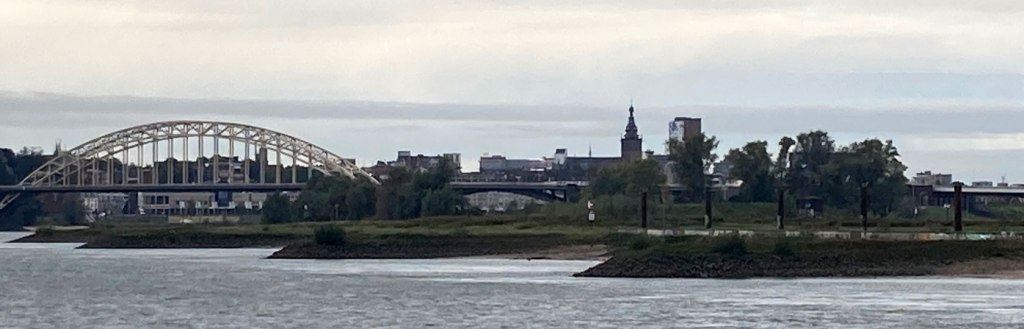
The water level on the Rhine and its tributaries continues to be low. It was pointed out that normally, when our ship is tied up in Nijmegen, the upper deck is at the same level as the riverwalk on shore. Not so today. A ramp had to be set up for us to disembark. Fortunately for commerce, the lower water level doesn’t seem to have impacted the constant flow of cargo ships back and forth past our cabin window. “
“Why Nijmegen?” you may ask. During WWII, as the Allies swiftly marched off the D-Day beaches into France and Belgium, their advance was halted at the Belgian/Netherlands border. To end the stalemate, Nijmegen and the surrounding area became ground zero for the military’s Operation Market Garden. The objective was to capture bridges across the lower Rhine to create an invasion route into northern Germany. And, while they failed in their main objective of capturing the bridge at Arnhem, the combined paratrooper and land invasion successfully liberated Nijmegen from the Nazis.
As we began our group walking tour, PD Julia started her narration by pointing out a distant sculpture on the opposite shore, Viewpoint. It is a large Roman mask meant to symbolize the historic face of Nijmegen, which is the oldest Roman city of the Netherlands. Sadly, from our perspective, it looks like a little golden Buddha peeking out shyly between buildings.
As we strolled down streets mostly rebuilt after the war, Julia explained the destruction of the city was caused by a mistaken Allied bombing raid before its liberation. Navigational errors misidentified the Dutch city as a German city and they opportunistically bombed it, killing around 800 civilians and destroying the city center.
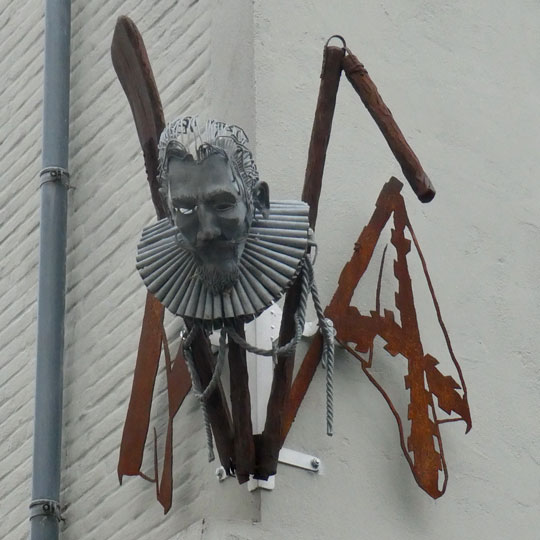
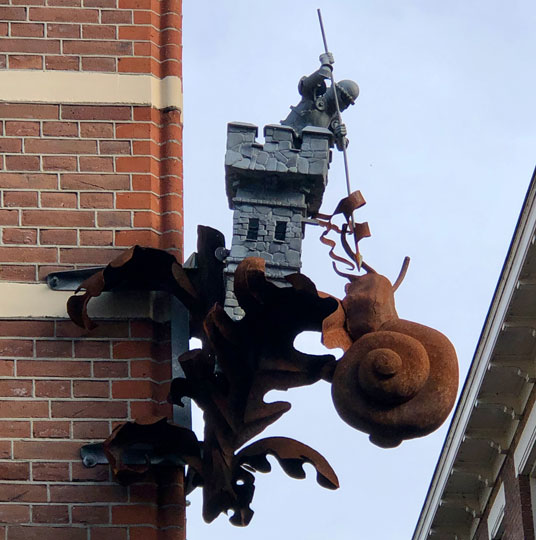
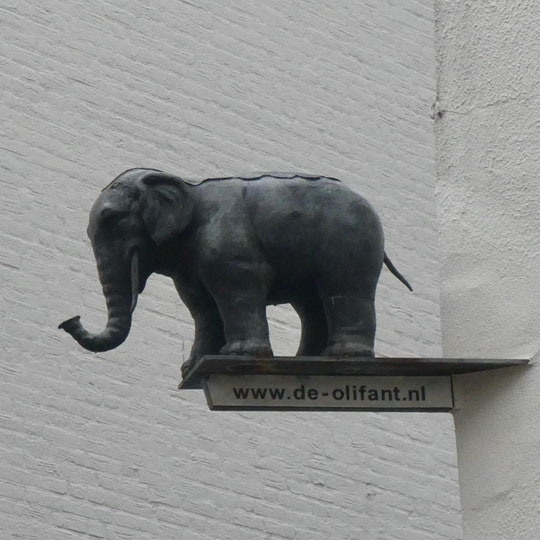
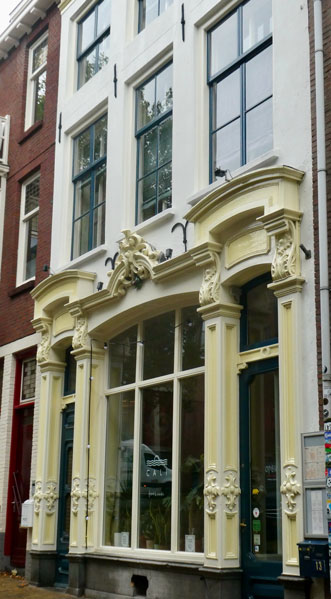
As we snaked through back streets on our way to St. Stephen’s and the city’s market square, we noticed several interesting artworks high up on several buildings. Some had associated stories, like the Elizabethan collar’d gent who apparently committed suicide. The others just piqued our interest.
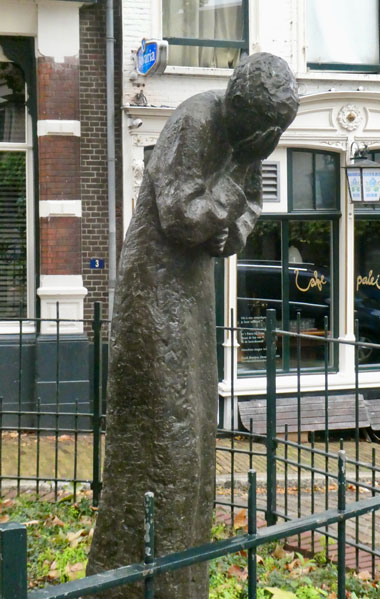
Continuing our move away from the Waal riverfront and deeper into Nijmegen, we found ourselves at a small fenced-in roundabout with a single tree shading the memorial statue of a young Jewish girl, Kitty de Wijze.
Pre-war, this had been a Jewish area of Nijmegen. In 1942, the Nazi rounded up and sent off many local Jews including Kitty and her sister Joke. Initially confined in a Netherlands concentration camp, they were both deported to Auschwitz and killed in December.
However, while en route, the girls wrote letters to their parents, reassuring them that they were well, that the arrangements were good and that the train ride was comfortable. Kitty even wrote with mistaken optimism that she hoped wherever they are going would be wonderful as well. They tossed their letters from the train in the hopes that they would be found and forwarded, which is what happened. Tragically, they were both gone long before their letters reached Nijmegen. The rest of their family was gassed at Auschwitz in late 1943.
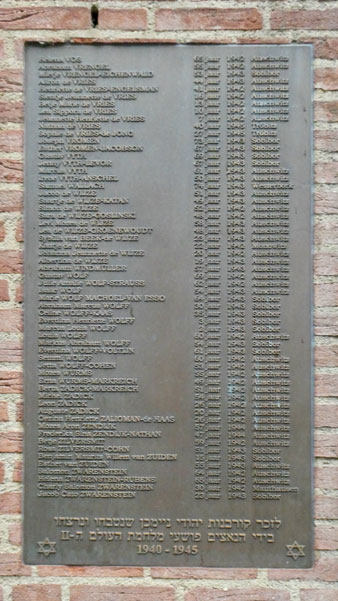
Complimenting the solitary figure, on an adjacent building are mounted a group of bronze plaques listing the more than 400 murdered Jews of Nijmegen.
After this sobering pause in our tour, we continued on to one of the main streets of Nijmegen where our group stopped again, wide-eyed and drooling. We gathered before a Dutch “Kaas” or cheese shop. (The finest in town as per our PD.) The window display case was stacked with huge wheels of cheese, particularly gouda in its various stages of aging. If only one could “consume” cheese with one’s eyes.
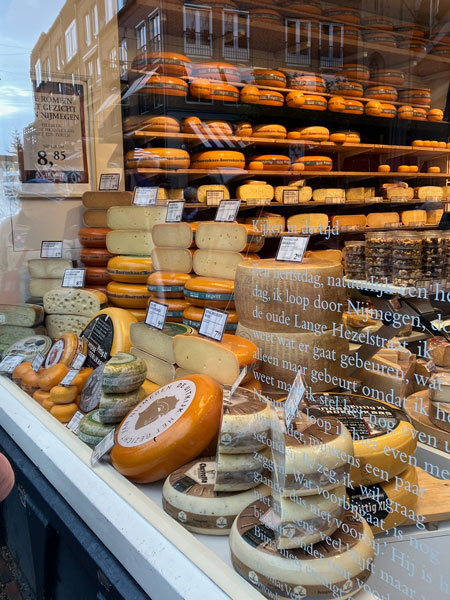
But I think Julia was just whetting our appetites for what was to come. (Unfortunately, I forgot to return and pick up a sampling of this savory delight.)
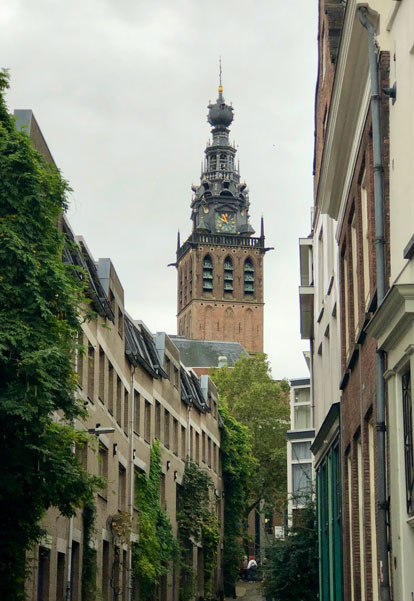
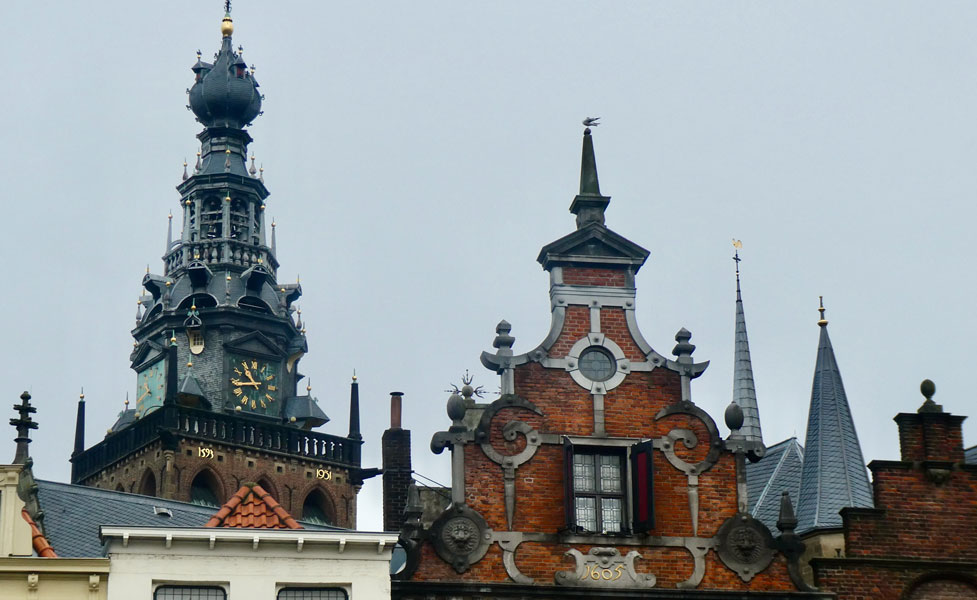
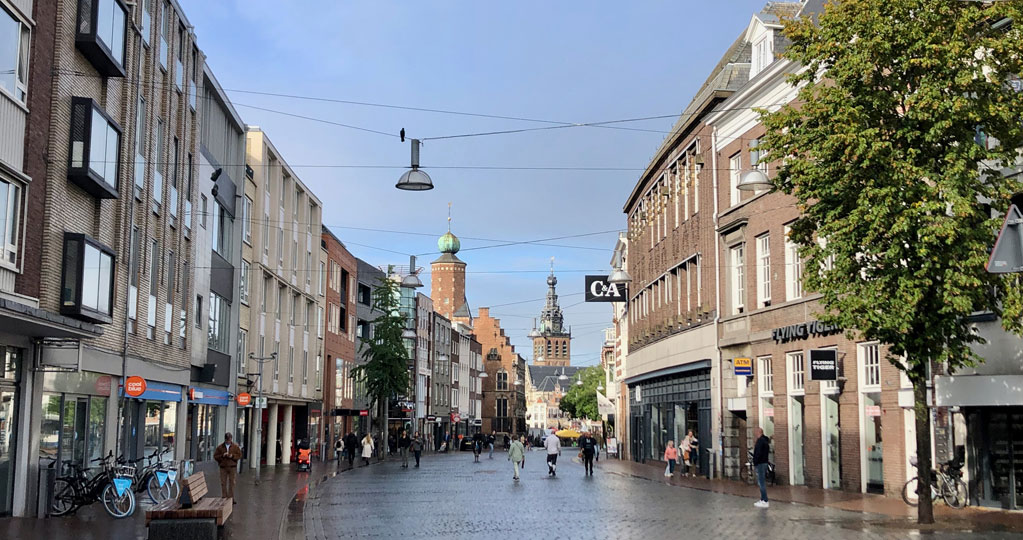
But, march on Red Group! Our goal was the Great Church, Stevenskerk or St. Steven’s Church, whose intricate spire is both a beacon and a lure from nearly anywhere in town. The building is still used for Sunday services as well as for weekly organ concerts on its famous König organ, exhibits, lectures, and more.
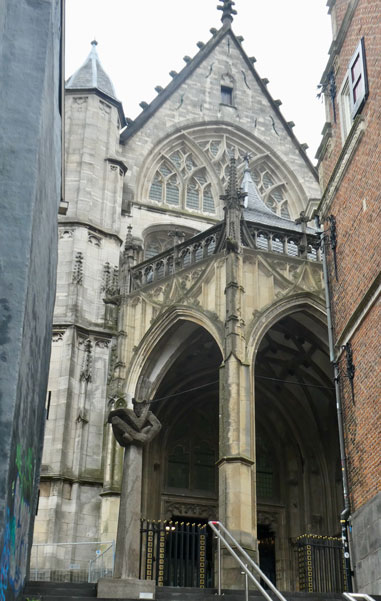
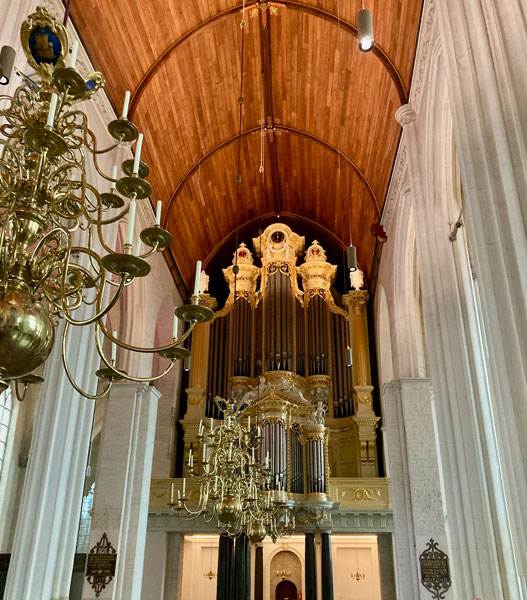
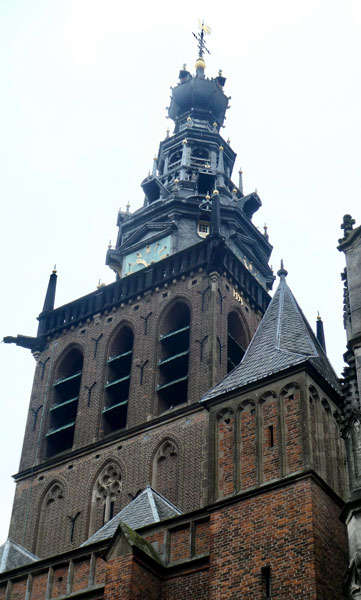
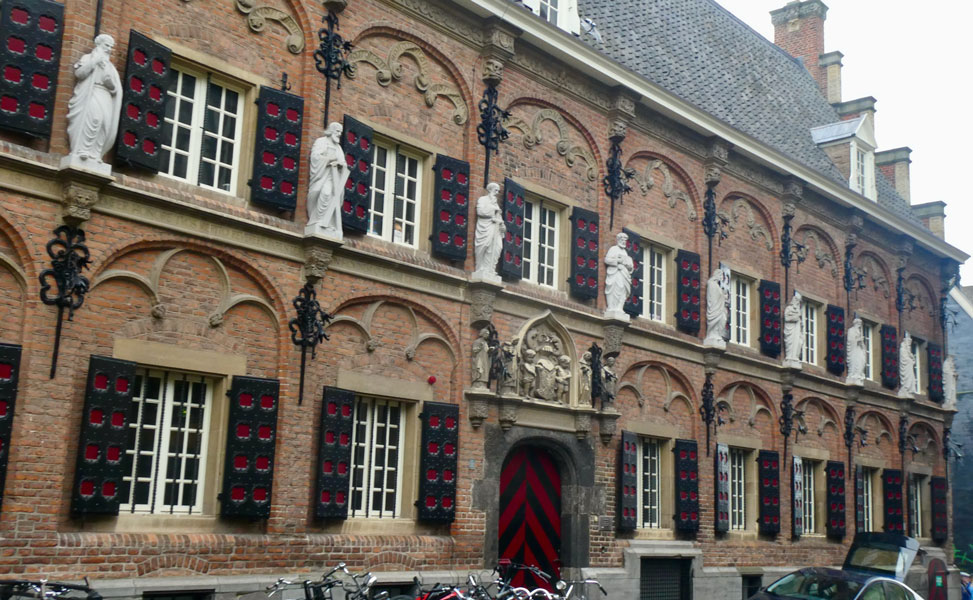
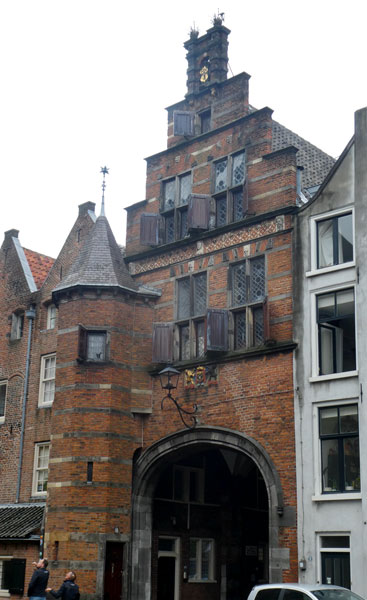
Across from the church, the twelve apostles keep a watchful eye on the proceedings from their perches on what had once been the St. Stephen’s Church school, a Latin school for boys. It now houses city offices. And, just beyond the former school is the church gate, created in the 1500’s, to link the churchyard with the Grote Markt
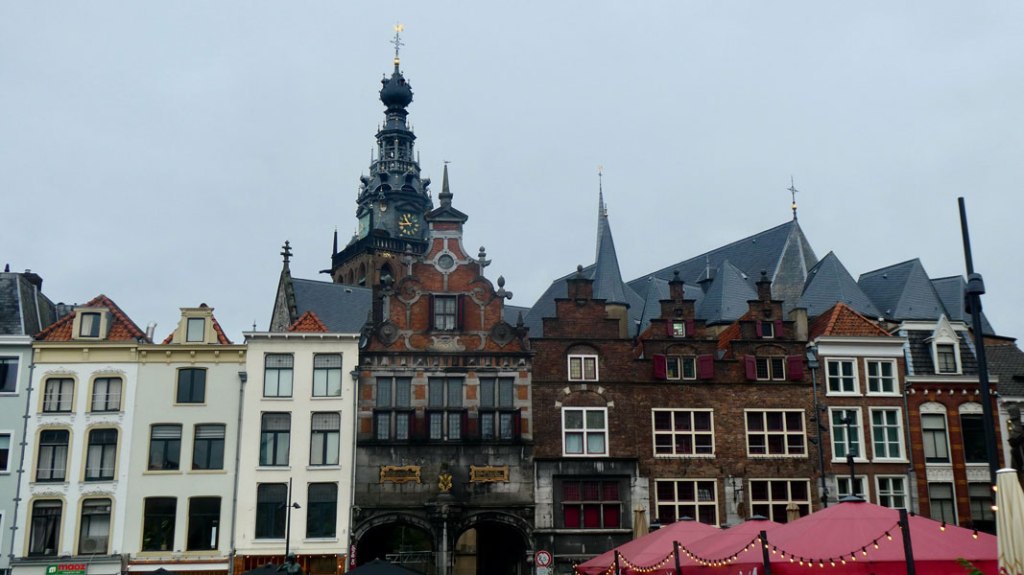
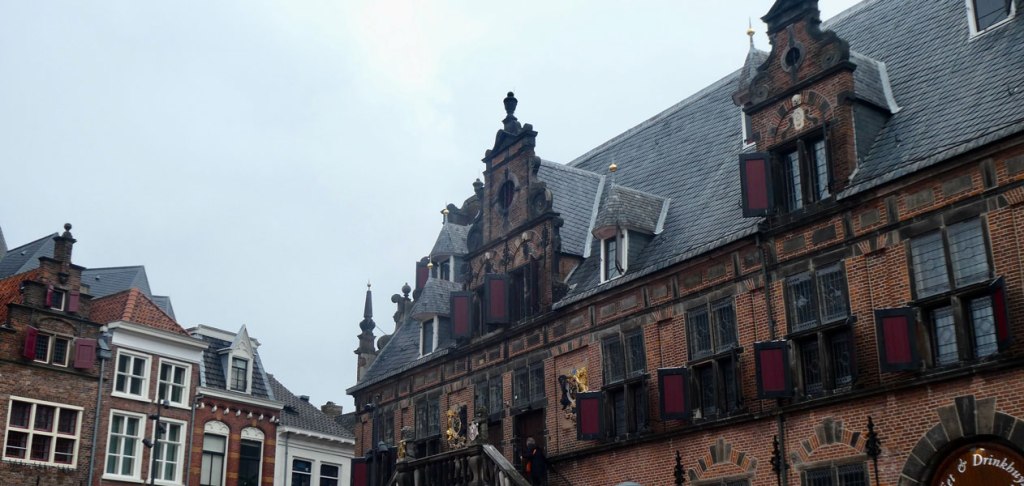
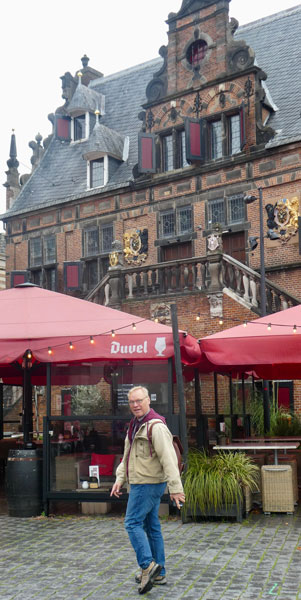
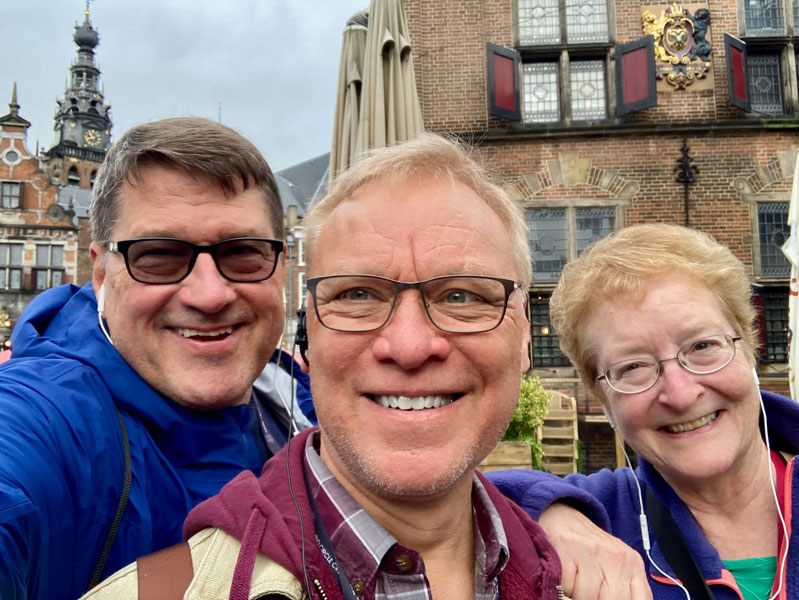
Nijmegen’s Grote Markt is, like the many we’ve encountered on this trip, lined with shops and restaurants, cafes spill out onto the cobblestone pavement and has been rebuilt to recapture the pre-war medieval feeling that tourists, particularly Americans, expect of such towns. Fortunately, Nijmegen had a few unique touches that helped distinguish it from every other “market” we photographed.
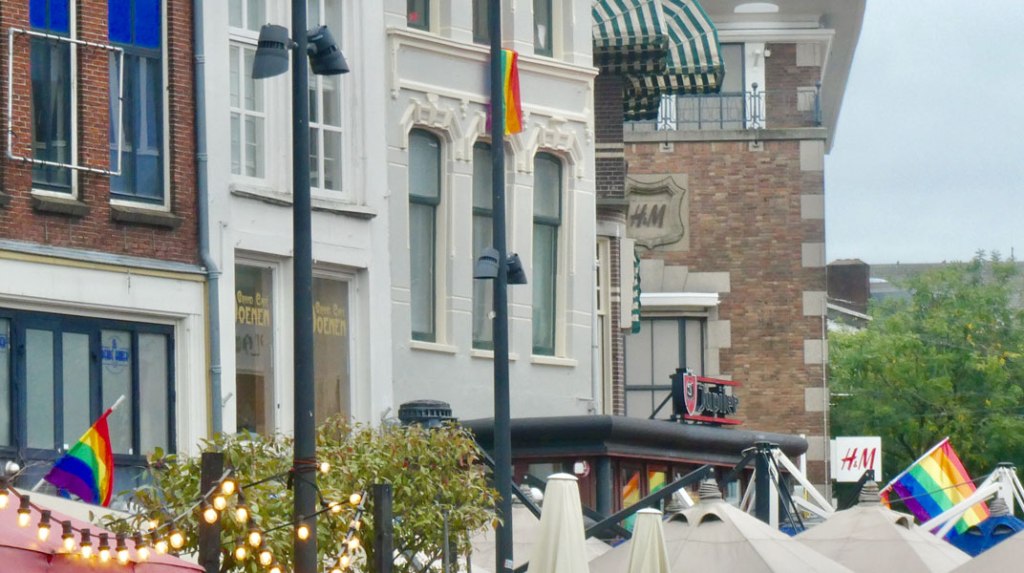
There were little artistic touches as discussed earlier mounted on building corners. And there were four rainbow flags flying along a stretch of restaurants and cafes that one couldn’t miss.
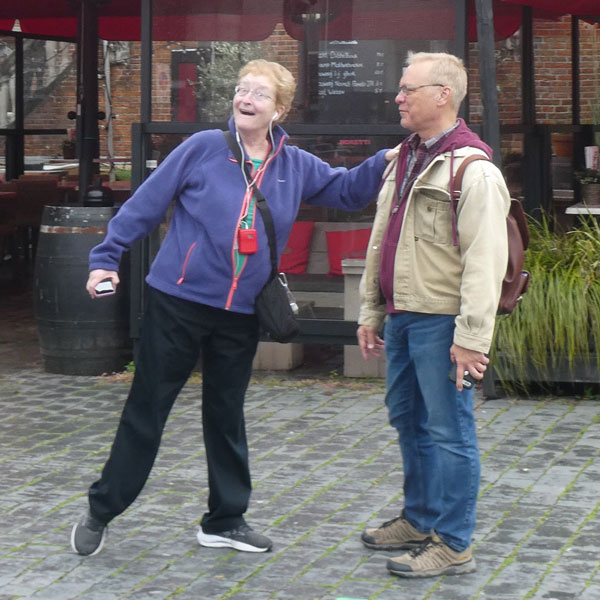
Before our group was set free to explore the town individually, Julia corralled us to a nearby food vendor for two tastes of local cuisine: chopped pieces of cold herring with onions; and kibbeling, (fried cod) with a remouladesauce — kind of a Dutch fish-n-chips sans the chips. We–Rob and I–tried both. Peg, a little less culinarily adventurous, only tried the kibbeling…and liked it very much. (She wanting nothing to do with the herring!) Both were delicious, especially the kibbeling dipped in the sauce. Seconds, thirds and beyond were enjoyed until it was gone.
The highlight of the stop however, after the delicious cod, came when a local woman, oblivious to us, purchased a fully prepared herring (no head), picked it up by the tail, tilted back her head and bit off a healthy chunk. Our group’s expressions ranged from disgust to disbelief to delight, all while frantically tried to get their cameras ready for the next bite.
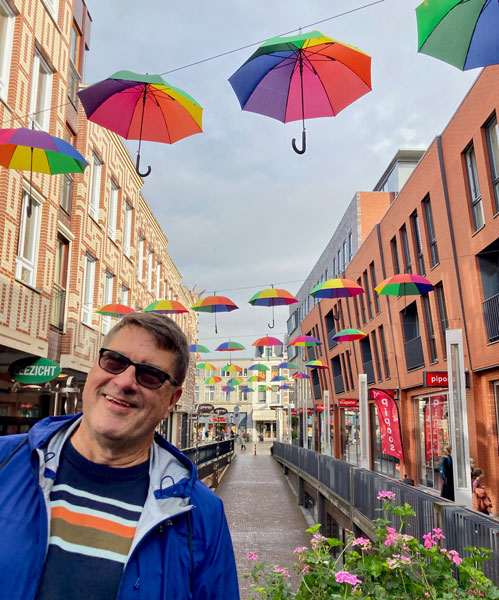
Walking through town, we did a little TKMaxx shopping–and almost buying–before coming upon a pedestrian shopping street that was reminiscent of the Old Arcade in Cleveland. There were street-level walkways lined with shops on the left and right with a staircase descending to a lower level, open to the sky, lined with shops as well. Halfway down, there was a small bridge connecting the two upper paths.
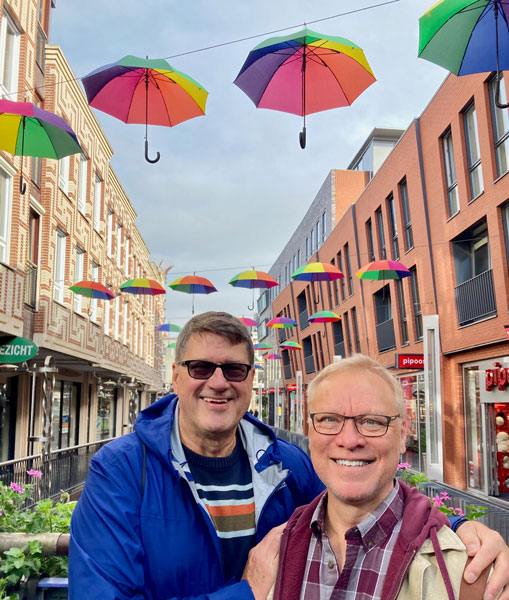
And overhead was an installation of rainbow-colored umbrellas strung from side-to-side and running the length of the shopping arcade. Of course, out came the camera!
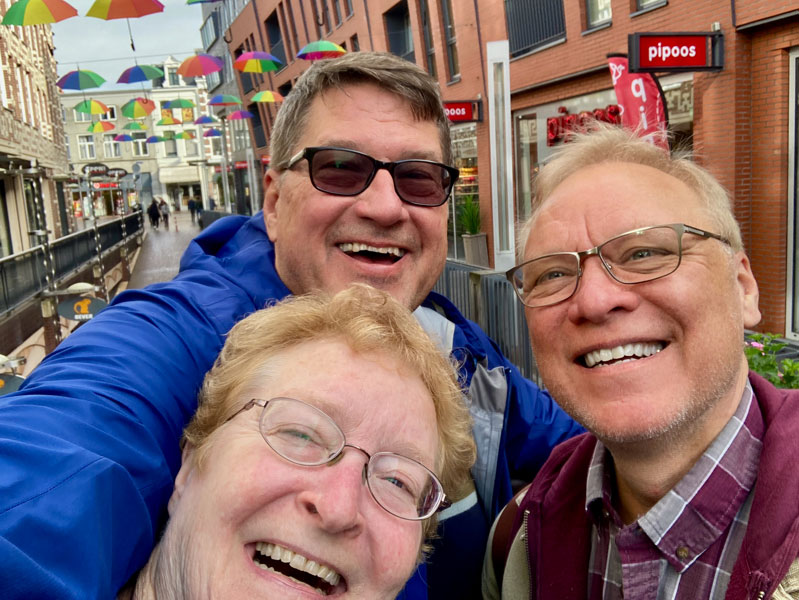
Having reached the end of the Grote Markt, we wrapped up our visit to Nijmegen and headed towards the Waal embankment. But not before being distracted by more bright colors!
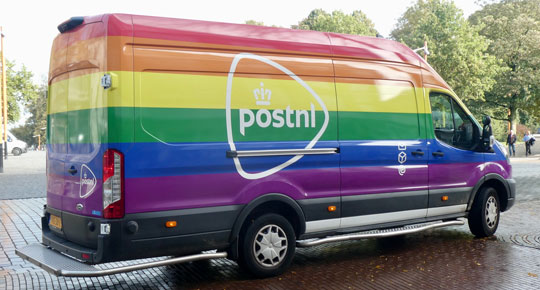
First, and entirely appropriate for this rainbow town, was the postal van in the brilliant colors of the pride flag delivering packages on the square.
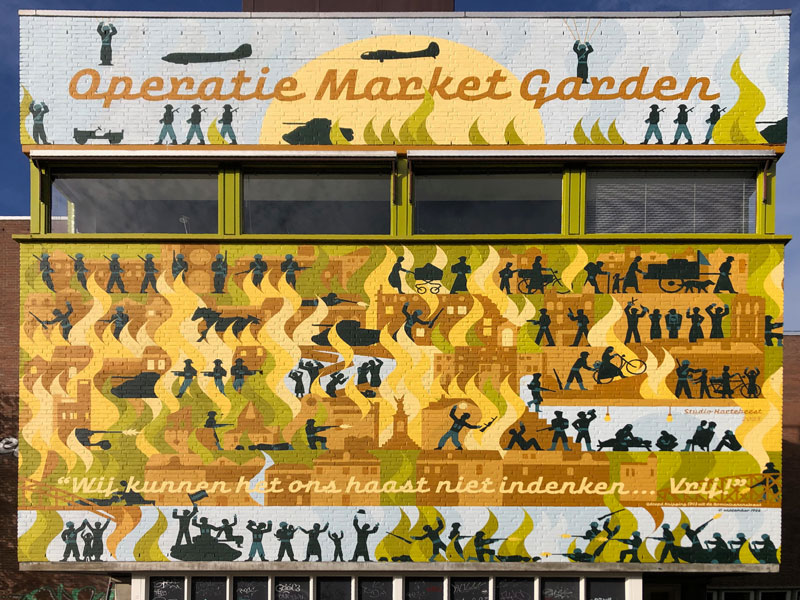
Then we passed a huge mural covering two sides of what appeared to be a school building that depicted the Operation Market Garden liberation of Nijmegen.
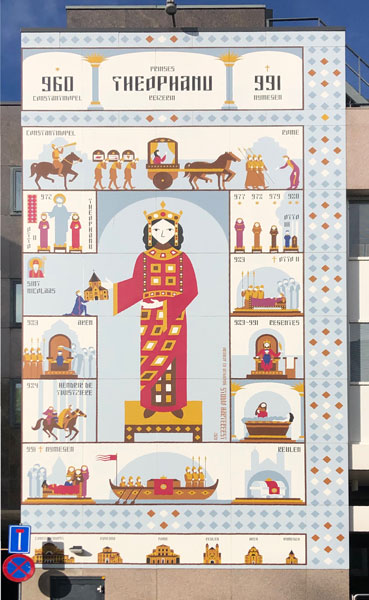
But I found the third mural really fascinating. Oddly placed in Nijmegen is this storybook mural depicting the real-life story of Empress Theophanu (960-991). A Byzantine princess, she was wed to the Holy Roman Emperor Otto II to create an alliance between the two empires. I investigated who she was and it is amazing how all the major events of her life are depicted graphically: her arrival and marriage; her four living and one deceased children; the kidnapping and return of her only son; her reign as regent for her underage son, Otto III; all that and more is depicted.
But again, I ask, “Why Nijmegen?” and “Why here?” There doesn’t appear to be any historic connections between the young Germanic Empress and this Dutch town. It remains a mystery. However, I thoroughly enjoyed deciphering the story of her short but event-filled life as revealed panel by panel.
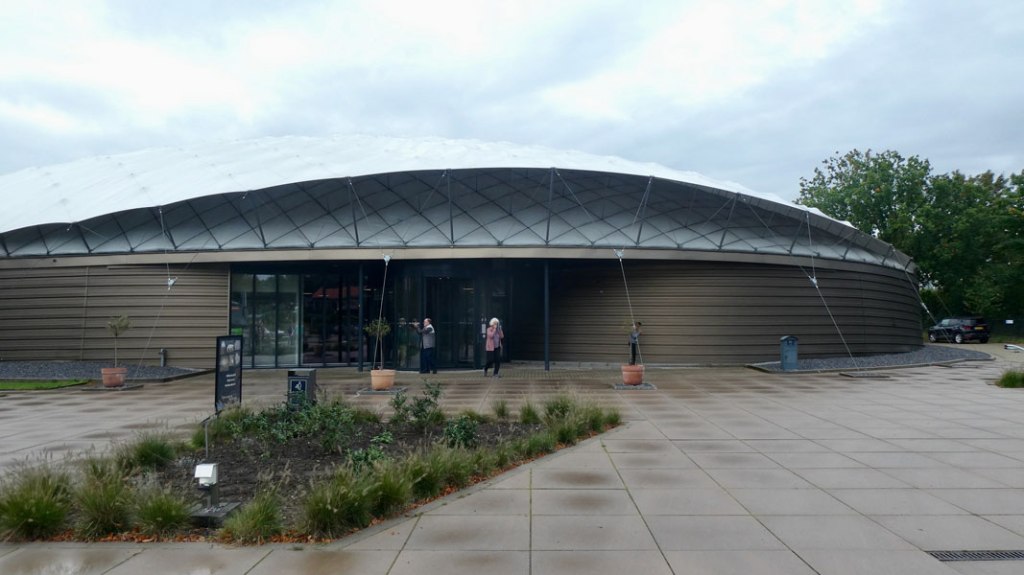
After lunch, there was a bonus excursion to the Freedom (Vrijheids) Museum in nearby Groesbeek. The museum building, a 12-meter high dome, resembles an enormous open parachute, a visual tribute to the thousands of paratroopers dropped in the area at the start of Operation Market Garden.
Inside, visitors can experience the fascinating story of war and freedom from the perspectives of the Netherlands, Germany, Europe and beyond through narrations, artifacts and interactive visuals that bring the experiences of living in occupied Netherlands alive.
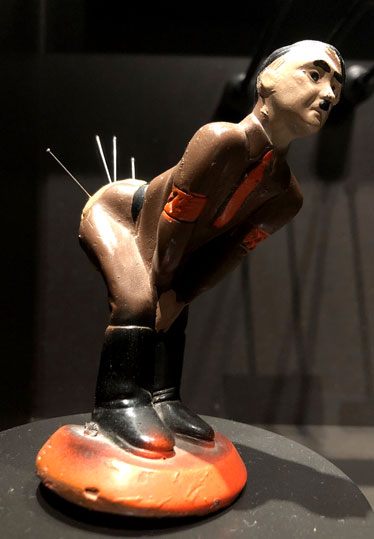
They have an actual Nazi flag donated to the museum by an American soldier who had acquired it during the liberation of Nijmegen and taken it back to the USA as a souvenir after the war. I held an actual piece of shrapnel that could sever off a man’s head if in motion. And there was a concrete facsimile of an underground bunker in which I experienced the uncertainty of waiting out a bombing raid overhead. (I, fortunately, was not alone for this harrowing experience.) And they have a genuine Hitler pin cushion…so sewers could stick it to the Führer will contributing to the war effort.
Sadly, I was so engrossed in the experience, I was only about two-thirds of the way through the museum when a docent approached me to ask if I was one of “the bus people?” We were leaving in five and I had run out of time. I hurriedly made for the exit.
However, I would highly recommend this museum to anyone coming to the area…and suggest they set aside 2-3 hours minimum to fully appreciate this thought-provoking institution.
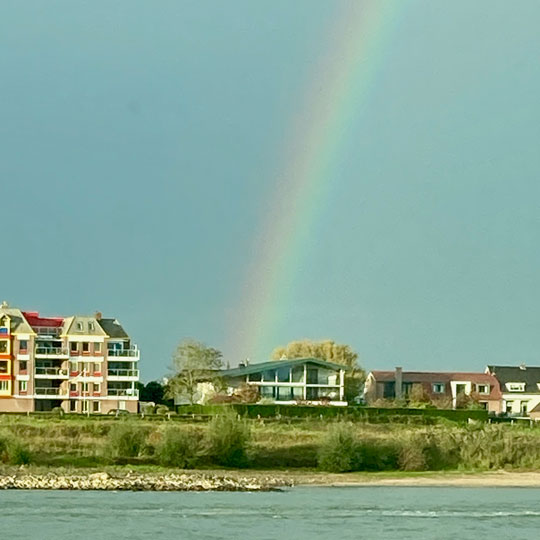
As the afternoon waned and rain began to gently fall, what could be more appropriate for this City of Rainbows than Mother Nature adding her two cents.
 Romance of the Rhine & Mosel
What a wonderful visit!
❤️ Nini
LikeLike